What is the LiFePO4 battery charge voltage?
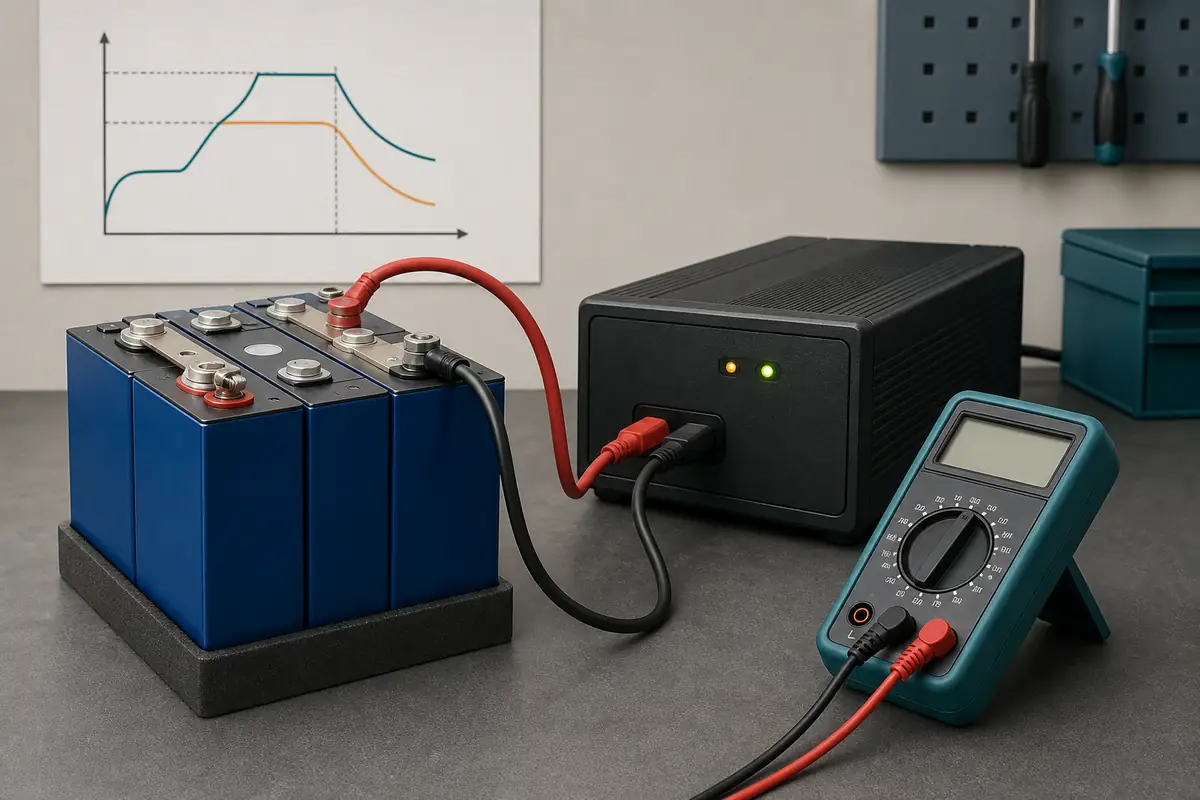
A LiFePO4 cell is commonly described as a 3.2 V nominal cell, while many battery specifications use about 3.65 V per cell as the upper charge reference. A pack's charge voltage is the cell reference multiplied by the number of cells connected in series. It is therefore the series count, not the marketing label alone, that determines the charger voltage.
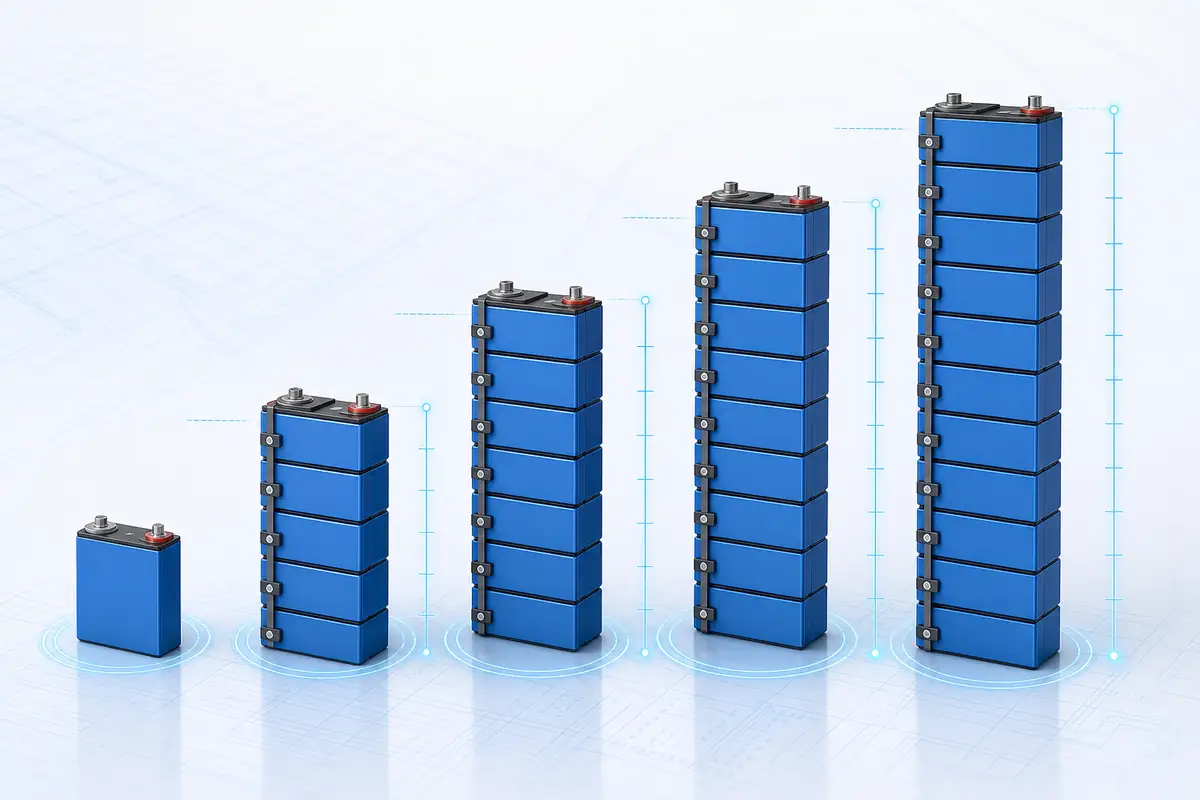
For example, a battery sold as 12 V LiFePO4 is usually a 4S pack with a nominal voltage near 12.8 V. Its common maximum charge target is 14.6 V when the cell maker and battery maker specify 3.65 V per cell. A 24 V battery is often 8S and a 48 V battery is often 16S, but confirm the actual series count on the label or data sheet before charging.
- Use the manufacturer's charge-voltage range when it differs from the common reference.
- Do not use a lead-acid, AGM or generic lithium profile just because the pack label says 12 V or 24 V.
- A BMS high-voltage cutoff is a protection boundary, not a substitute for a correctly configured charger.
LiFePO4 charge voltage chart by cell count
The table below shows a common 3.65 V-per-cell reference. It is useful for checking arithmetic and spotting an obvious mismatch, but it does not override a battery data sheet. Some manufacturers recommend a lower daily charge voltage to reduce stress or to suit a particular BMS and charger combination.
The nominal voltage column describes the pack's usual operating label. The charge target column describes the voltage at the top of a full charge, not the voltage you should expect at every moment during charging.
| Common pack label | Series count | Nominal pack voltage | 3.65 V/cell reference |
|---|---|---|---|
| 12 V LiFePO4 | 4S | 12.8 V | 14.6 V |
| 24 V LiFePO4 | 8S | 25.6 V | 29.2 V |
| 36 V LiFePO4 | 12S | 38.4 V | 43.8 V |
| 48 V LiFePO4 | 16S | 51.2 V | 58.4 V |
Charge voltage, resting voltage and load voltage are different
A charger can hold a battery near its charge target while current gradually falls in the constant-voltage stage. After the charger is removed and the pack rests, the terminal voltage normally settles lower. When an inverter or motor draws current, the reading can fall again because of internal resistance, wiring loss and the current load.
This is why a single voltage reading cannot prove state of charge or battery health. Compare the charging state, current direction, temperature, cell spread and time since the charger was disconnected. A freshly charged pack can also show surface-charge effects, while a weak connection can create a misleading drop under load.
- Charging voltage: measured while the charger is actively controlling the pack.
- Resting voltage: measured after the battery has been disconnected and allowed to settle.
- Load voltage: measured while equipment is drawing current and therefore affected by the load path.
Match the charger, battery and BMS
A suitable charger must use a LiFePO4-compatible constant-current/constant-voltage profile and the correct pack voltage. Check the charger output label, battery series count, maximum charge current, temperature restrictions and connector polarity. A charger with the wrong chemistry profile can keep pushing an unsuitable voltage even if its nominal label looks close.
The BMS protects cells and switches the pack off when configured limits are reached; it is not a precision charger. A Bluetooth BMS app such as BAT BMS may show total voltage, cell voltages, current, temperature and alarms on compatible hardware, but an app screen cannot confirm that an unknown charger is safe. Do not raise overvoltage or balancing thresholds to force a charge to finish.
- Confirm chemistry and series count before connecting the charger.
- Use the battery maker's continuous charge-current limit, not a charger maximum guessed from capacity.
- Treat repeated high-voltage, temperature or cell-imbalance protection as a stop-and-diagnose event.
How to measure a LiFePO4 battery safely
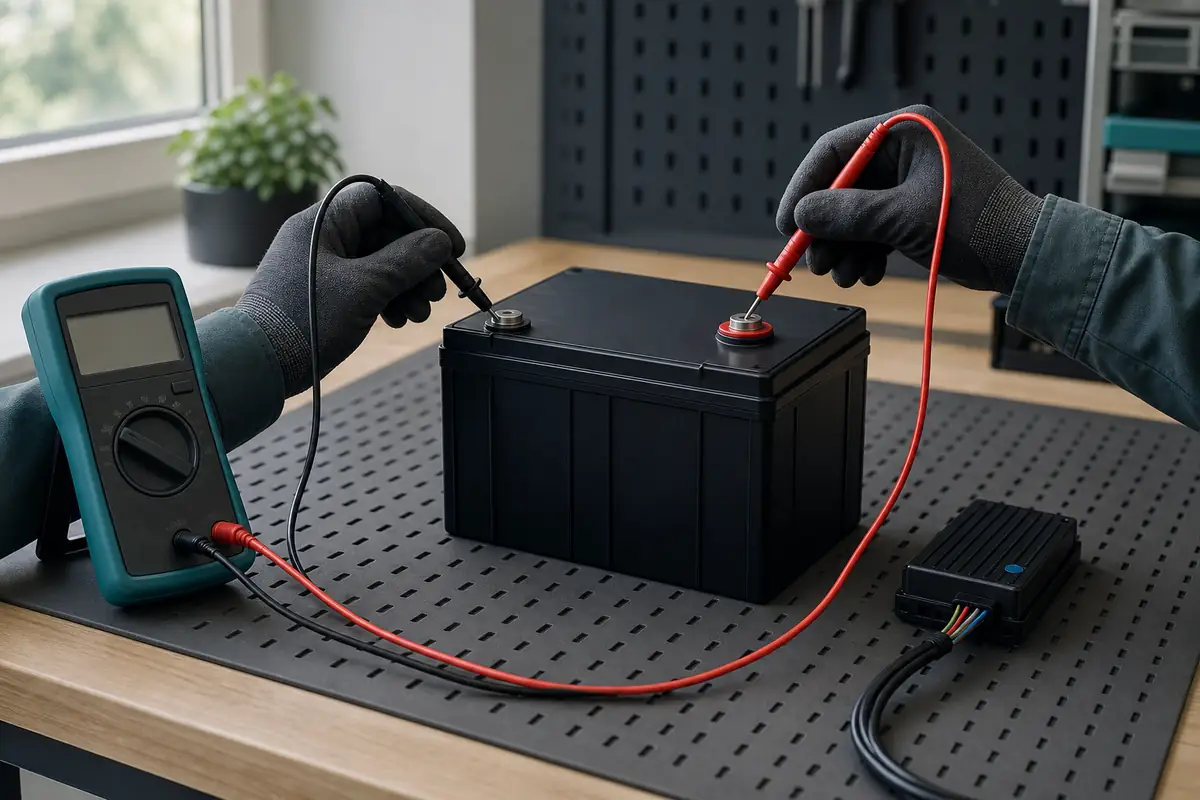
Use a suitable digital multimeter on an intact pack, verify the meter range and inspect the probes before touching the terminals. Keep the probes from bridging adjacent terminals, measure positive to negative with the correct polarity, and record whether the charger is connected. If the pack is swollen, hot, damaged, wet, leaking or producing an unusual smell, stop and use a qualified service route instead of probing it.
A pack-terminal reading checks the external voltage only. It does not reveal every cell voltage, internal connection or BMS setting. For compatible hardware, compare the meter reading with the BAT BMS total-voltage and cell-voltage screens, then investigate a large or repeating mismatch through the battery maker or BMS supplier.
- Measure in a ventilated, dry area away from conductive loose objects.
- Keep the charger disconnected when taking a baseline resting reading.
- Never short terminals, bypass a fuse or disable BMS protection to obtain a reading.
How to charge a LiFePO4 battery for the first time
Before the first charge, read the battery manual and confirm the chemistry, series count, maximum charge current, allowed temperature range and charger type. Check the case, terminals, cables, fuse and BMS connector. Place the battery on a nonflammable, stable surface with ventilation, stay nearby during the first supervised cycle and keep a record of voltage, current, temperature and alarms.
Connect only after the charger output and polarity have been verified. Watch the cell readings near the top of charge rather than relying on the pack total alone. Stop when the battery maker's conditions are met, when protection repeats, when one cell rises abnormally, or when the pack becomes hot or physically changes. A normal-looking percentage in a BMS app does not overrule a physical warning sign.
- Do not charge a LiFePO4 pack below the manufacturer's minimum charging temperature.
- Do not leave an unknown battery and unknown charger connected unattended.
- After charging, disconnect the charger and allow the pack to settle before comparing resting voltage.
LiFePO4 battery charge voltage FAQ
What is the full charge voltage for a 12V LiFePO4 battery?
A common 4S 12.8 V LiFePO4 pack uses 14.6 V as the 3.65 V-per-cell upper reference. Confirm the exact battery manual because some packs specify a lower daily target or a different permitted range.
What is the full charge voltage for a 24V or 48V LiFePO4 battery?
A common 8S 25.6 V pack uses 29.2 V, and a common 16S 51.2 V pack uses 58.4 V, when the 3.65 V-per-cell reference applies. Verify series count and manufacturer limits before charging.
How do I know when a LiFePO4 battery is fully charged by voltage?
Voltage alone is not enough. Check the charger stage, falling charge current, cell-voltage spread, temperature and the battery maker's completion conditions. A resting voltage after the charger is removed cannot prove capacity or cell health by itself.
How do I charge a LiFePO4 battery for the first time?
Confirm chemistry, series count, charge current, temperature limits and charger profile first. Inspect the pack, supervise the first cycle in a ventilated area, record BMS values and stop for repeated protection, abnormal heat, a rapidly rising cell or physical damage.
Can I use a lithium battery charger for LiFePO4?
Only when its profile, voltage, current and termination behavior are explicitly compatible with LiFePO4 and the exact battery. The word lithium on a charger label does not identify the chemistry or make every pack safe.
Technical references
- Victron Energy LiFePO4 Battery Smart manual - Manufacturer documentation showing why charge limits, temperature and installation instructions must follow the exact battery model.
- Texas Instruments battery management overview - Technical background on cell monitoring, protection and battery-management functions.
- BAT BMS app manual - Site guide for reading compatible Bluetooth BMS values without treating the app as a charger safety proof.