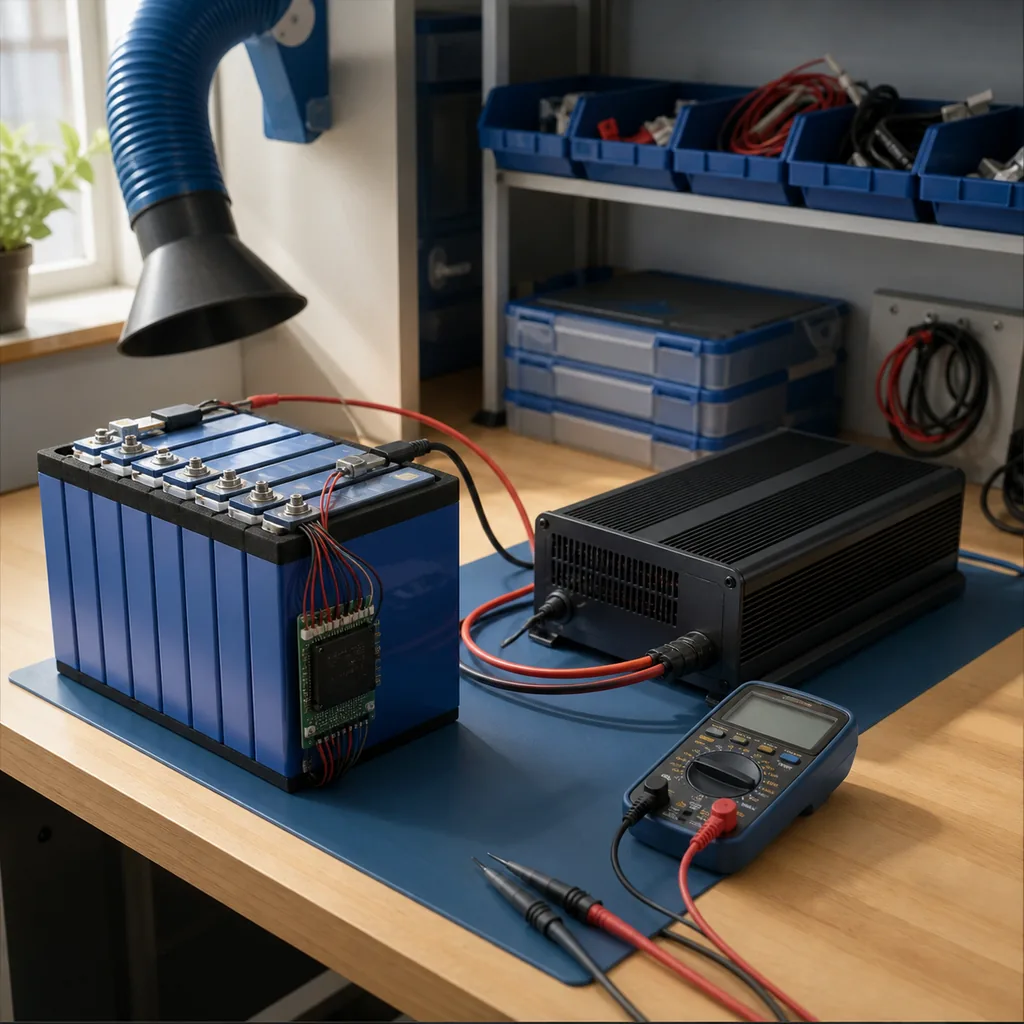
1. What makes a LiFePO4 battery charger compatible?
Compatibility is more than matching a label that says 12 V or lithium. The charger must be designed for lithium iron phosphate chemistry, deliver the correct pack-level voltage, use a suitable constant-current/constant-voltage profile, and stay within the battery's allowed charge current and temperature range. The battery maker's data sheet is the controlling source when it differs from a general chart or an online recommendation.
Before connecting a charger, write down the battery's nominal voltage, series count, maximum continuous charge current, permitted charging temperature, connector polarity and any special sleep or wake instructions. Then compare those facts with the charger's output label and manual. If one required value is missing, treat the charger as unverified rather than guessing from its plug or wattage.
2. Match charger voltage to LiFePO4 series count
LiFePO4 cells are commonly described as 3.2 V nominal cells. A pack's nominal voltage is created by connecting cells in series, while the charger's top-of-charge voltage is higher. A common reference is about 3.65 V per cell at the upper end of charge, so a 4S pack may use 14.6 V and an 8S pack may use 29.2 V when the manufacturer allows those values. These are arithmetic references, not permission to override a battery specification.
Do not infer the series count only from a marketing label. A product sold as 12 V is often 4S and a 24 V product is often 8S, but the data sheet, label or battery supplier should confirm it. A charger that is too high can trigger overvoltage protection or damage cells; one that is too low may never complete the intended charge.
| Common pack label | Typical series count | Nominal voltage | 3.65 V/cell reference |
|---|---|---|---|
| 12 V LiFePO4 | 4S | 12.8 V | 14.6 V |
| 24 V LiFePO4 | 8S | 25.6 V | 29.2 V |
| 36 V LiFePO4 | 12S | 38.4 V | 43.8 V |
| 48 V LiFePO4 | 16S | 51.2 V | 58.4 V |
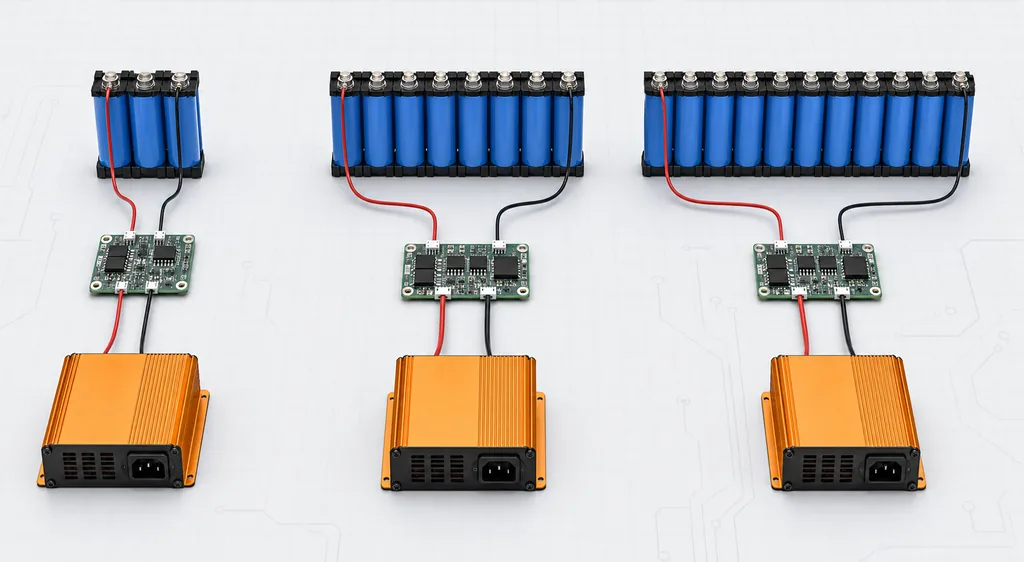
3. Choose a charge current the battery can accept
A charger rated for more amps is not automatically better. The battery maker normally lists a recommended or maximum continuous charge current, and the BMS may impose its own limit. A 100 Ah battery might be allowed to charge at 20 A, 50 A or another value depending on its cells, wiring, thermal design and warranty conditions. Do not calculate a safe current from capacity alone and do not assume the BMS will make an oversized charger safe.
The charger rating is its maximum available output, while the battery's charge-current limit is the value that must be respected. Check whether the charger tapers current during the constant-voltage stage, whether the cable and fuse are sized for the current, and whether the connector can handle heat. If the charger has selectable current modes, start with the battery maker's documented setting rather than the highest option.
4. Check the CC/CV profile, connector and temperature rules
A normal LiFePO4 charge uses a constant-current stage followed by a constant-voltage stage. Current is allowed to taper as the pack approaches the specified voltage. The exact voltage, termination current, balancing behavior and temperature limits vary by battery design, so a charger advertised only as a generic lithium charger is not enough evidence of compatibility.
Also check the physical connection. Confirm positive and negative polarity, connector size, plug keying, cable insulation and any inline fuse. Some batteries have a BMS sleep state or a low-temperature lockout. A charger that shows output voltage with no load may still be unsuitable once connected to a protected pack. Never use a loose adapter, a reversed connector or a makeshift jumper to defeat a protection state.
5. How to charge a LiFePO4 battery for the first time
First charging is a verification exercise, not a race to reach 100 percent. Inspect the case, terminals, cables, fuse and BMS connector. Confirm the chemistry, series count, charger voltage, current limit and temperature range. Place the battery on a stable nonflammable surface in a ventilated area where you can remain nearby. If the battery is swollen, wet, damaged, unusually hot or smells abnormal, do not connect the charger.
With the charger disconnected, record a baseline pack voltage when it is safe to do so. Connect only after checking polarity and the manufacturer's wake procedure. During charging, watch the charger, pack temperature, current, total voltage and compatible BMS cell readings. Stop if protection repeats, one cell rises sharply, the charger behaves unexpectedly, or the pack changes physically. After the charger finishes, disconnect it and let the battery settle before comparing a resting reading.
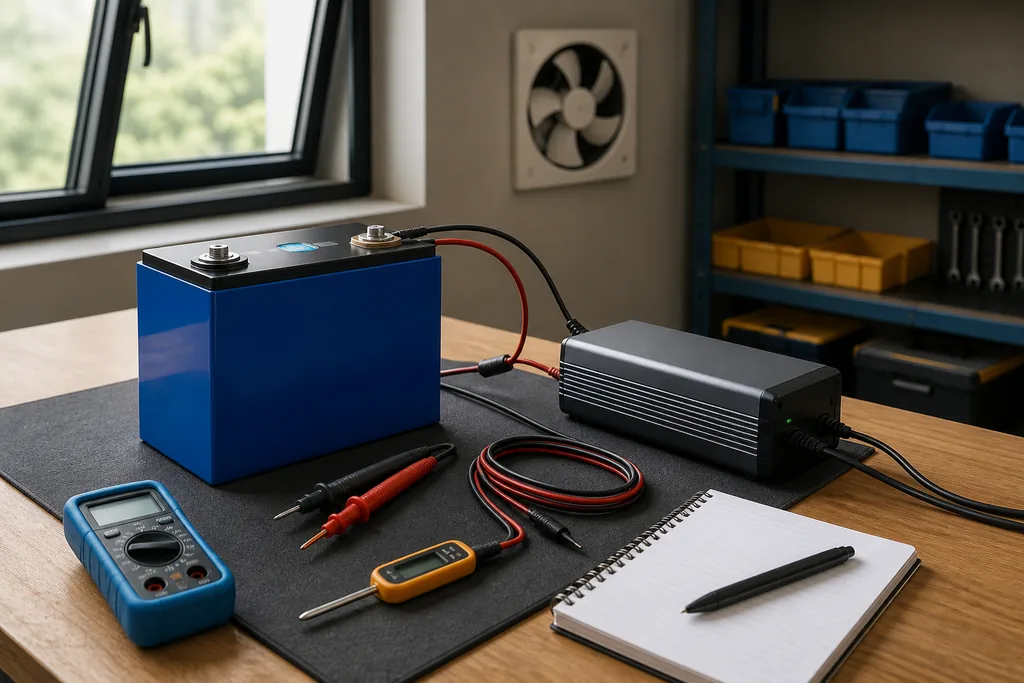
6. What to do when a LiFePO4 battery will not charge
A battery that appears dead may be in BMS sleep, low-temperature protection, overvoltage or undervoltage lockout, or have a charger, fuse, connector or communication problem. First inspect the pack and charger without opening or bypassing the protection system. Check the charger output against its documented specification, confirm polarity, and review the battery's permitted temperature and wake procedure.
Do not jump a LiFePO4 battery from another battery, connect a random bench supply, raise the charger voltage or short a BMS output just to force current. Those actions can remove the protection boundary while the cell condition is unknown. If the pack is damaged, hot, swollen, leaking, repeatedly trips protection or has a large cell mismatch, isolate it safely and ask the battery maker or a qualified technician for a pack-specific procedure.
7. Use a meter and BMS data together
A multimeter reading at the pack terminals tells you the external voltage at one moment. It does not prove every cell is balanced, the internal connections are healthy, or the BMS settings are correct. Measure only an intact pack with suitable equipment, avoid bridging adjacent terminals and record whether the charger is connected. A large mismatch between the charger output, pack terminals and BMS total voltage deserves investigation before another charge cycle.
On compatible hardware, the BAT BMS app can help you compare total voltage, individual cell voltage, current, temperature and protection states. Use it as a monitoring view, not as a charger safety certificate. A normal-looking app percentage cannot override a hot case, damaged cable, abnormal cell rise or repeated protection event. For balancing behavior, compare repeated readings under similar conditions and use the exact BMS documentation.
LiFePO4 battery charger FAQ
What charger do I need for a LiFePO4 battery?
Use a charger explicitly compatible with LiFePO4, matched to the pack's series count and specified charge voltage, with a current limit the battery and BMS allow. Confirm the connector, polarity and temperature rules in the battery manual.
Can I use a regular lithium charger for LiFePO4?
Only when its chemistry profile, voltage, current and termination behavior are explicitly compatible with LiFePO4 and the exact battery. The word lithium on a label does not identify one universal charging profile.
What charger voltage does a 12 V LiFePO4 battery use?
A common 12.8 V 4S pack uses 14.6 V as a 3.65 V-per-cell upper reference, but the battery maker's specified range takes priority. Do not choose a charger from the 12 V label alone.
How many amps should I use to charge a LiFePO4 battery?
Use the recommended or maximum continuous charge current in the battery documentation. Capacity alone does not prove a safe current; cells, wiring, BMS limits, temperature and the manufacturer's warranty conditions also matter.
Why does my LiFePO4 battery charger stop immediately?
Possible causes include BMS sleep or protection, low temperature, an incorrect charger voltage, reversed polarity, a fuse or connector problem, or a cell condition that needs service. Check the documented procedure and do not bypass protection to force current.
Can I charge a dead LiFePO4 battery with a power supply?
Do not use an unverified power supply or improvised recovery method. A protected or damaged pack may not be safe to force-charge. Follow the battery maker's documented recovery procedure or ask a qualified technician when the pack is locked out or physically abnormal.
What is the right 12V LiFePO4 battery charger?
For a common 12.8 V 4S pack, a charger with a documented 14.6 V upper target may be compatible, but use the battery maker's specified voltage and current first. Confirm LiFePO4 chemistry, connector polarity, temperature limits and BMS rules before connecting.
Technical references
- Victron Energy LiFePO4 Battery Smart manual - Manufacturer documentation for charge limits, temperature rules and installation conditions of a specific LiFePO4 battery family.
- Texas Instruments battery-management overview - Technical background on cell monitoring, protection and battery-management functions.
- LiFePO4 battery charge-voltage guide - Site reference for pack voltage arithmetic and 12 V, 24 V, 36 V and 48 V charge-voltage examples.